Avoiding Grout Haze: A Specifier's Guide to a Flawless Finish

Read More
Surface Studio work with leading interior designers across Australia sharing expert tiling advice, information and related services. Contact us today regarding your next project.
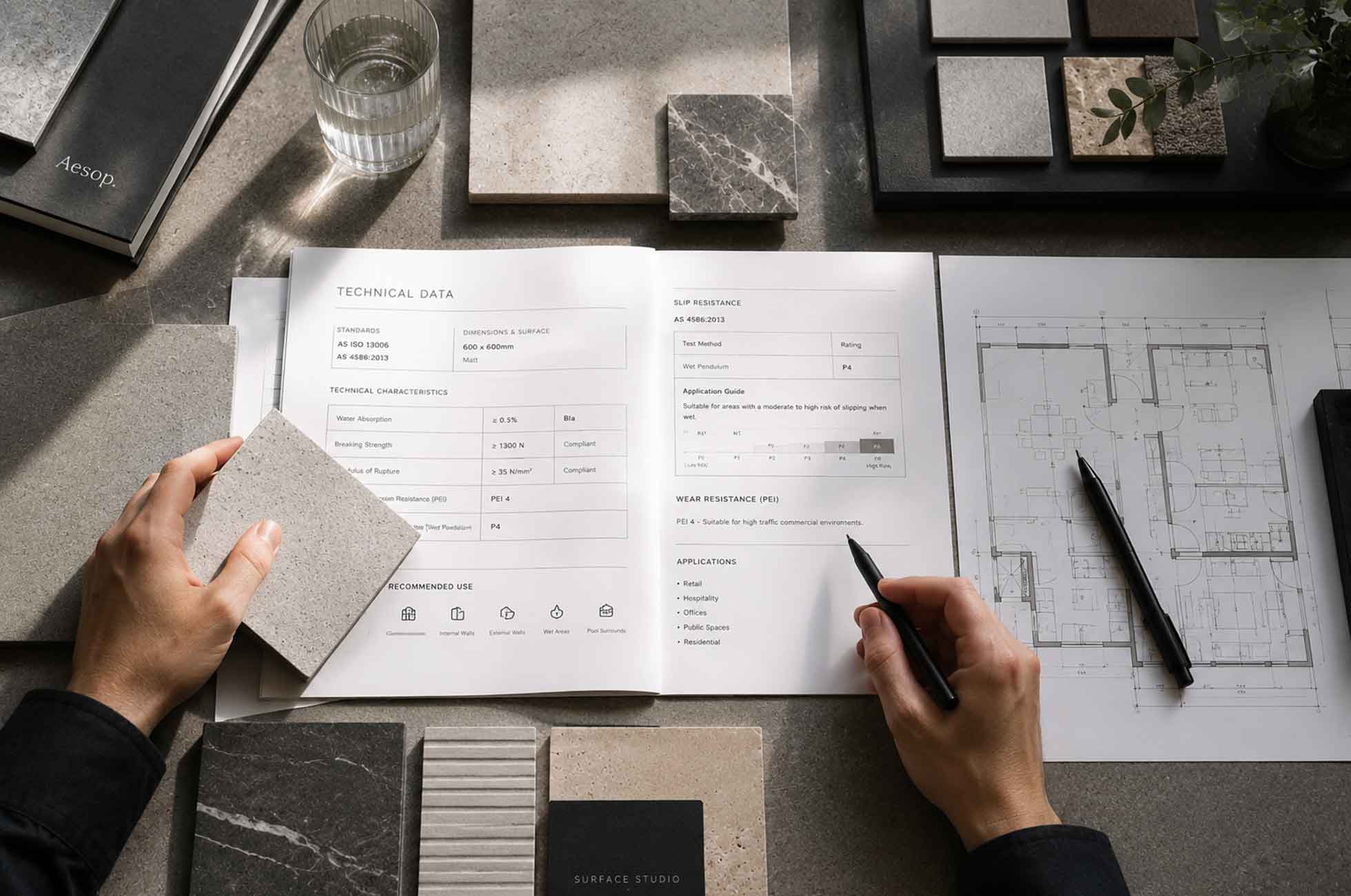
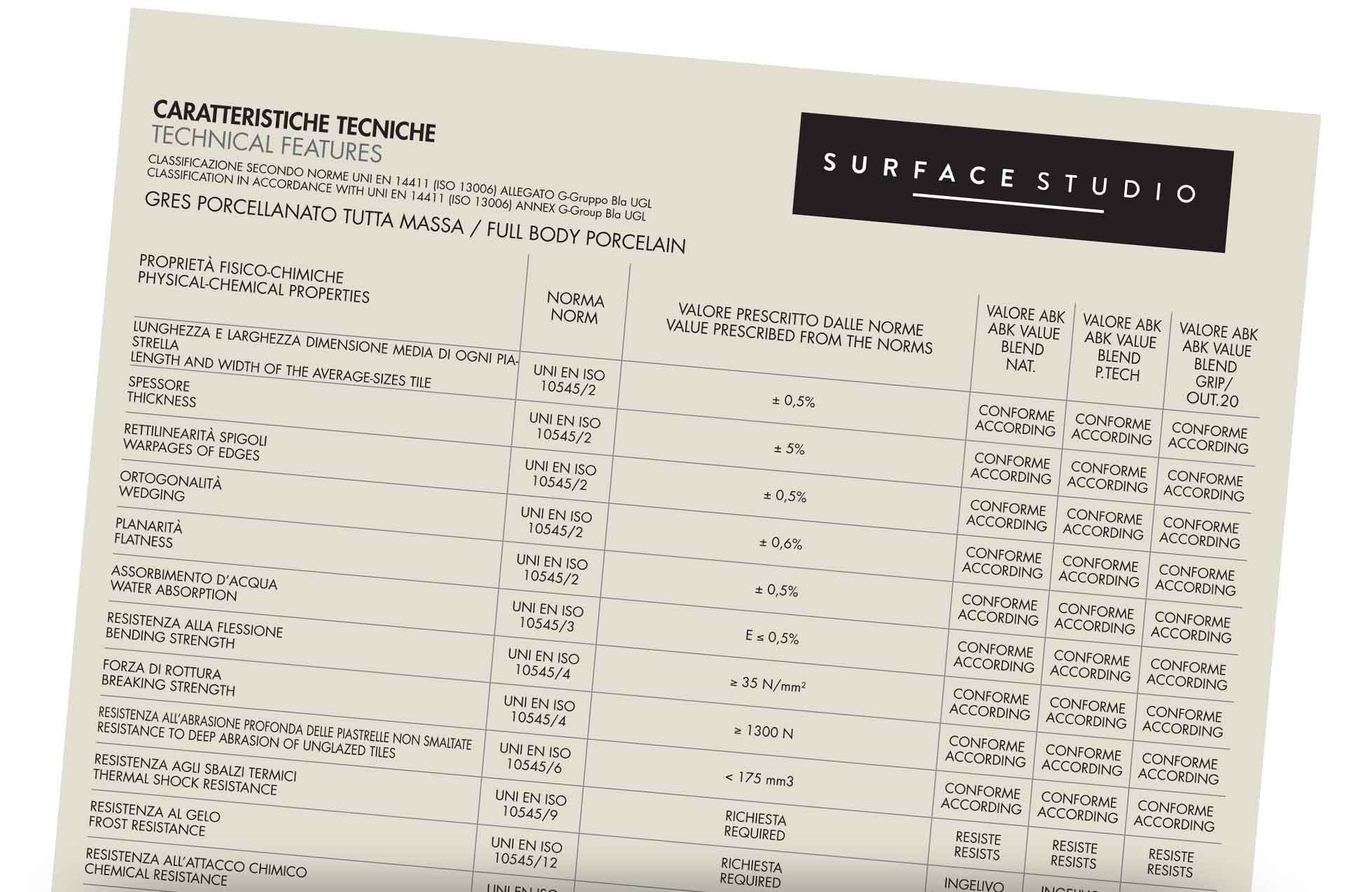
Most quality tiles come with a technical data sheet (TDS), but many building professionals overlook it.
That is a missed opportunity. A TDS provides the performance data needed to confirm a tile is suitable for its intended use before installation and before complaints arise.
In Australia, tile performance is governed primarily by AS ISO 13006 (the adopted international standard for ceramic tile classification) and AS/NZS 4586 (slip resistance). Understanding these metrics is straightforward once you know what to look for. Here is a guide to the four most important values on a tile TDS.
The PEI (Porcelain Enamel Institute) wear rating indicates how well a glazed tile surface holds up to foot traffic. The scale runs from Class 0 (no foot traffic) to Class 5 (heavy commercial). Under AS 3958.2 — Guide to the Selection of a Ceramic Tiling System — tile selection must match the intended traffic classification:
For most Australian commercial applications, a minimum PEI Class 4 is required for floor tiles. Selecting a Class 3 tile for a commercial application is a common and costly error — the surface will degrade within months under the traffic loading it was not rated for. Note that PEI ratings apply to glazed tiles only; unglazed through-body porcelain tiles are assessed on density and hardness rather than surface glaze wear.
Australia uses a different slip resistance framework to North America and Europe, and it is essential that Australian specifiers understand the local system. The primary standard is AS/NZS 4586:2013 Slip Resistance Classification of New Pedestrian Surface Materials, supplemented by HB 197:1999 and HB 198:2014 — the latter providing application-specific guidance for specifiers.
AS/NZS 4586 provides four test methods, each producing a different rating scale:
HB 198:2014 provides a Table 3B reference guide to minimum slip ratings for a wide range of Australian environments, from aged care facilities (P4 or higher recommended) to retail shopping centres (P3 minimum in wet areas) and pool surrounds (Class B or C on the barefoot ramp test). Specifiers should consult this Handbook — not just the P number on the TDS — when determining suitability.

Water absorption classifies how porous a tile is, and this has significant implications for where it can be used in Australian conditions. Under AS ISO 13006, tiles are classified as:
In Australia's tropical north and subtropical Queensland coast, the combination of high humidity, heavy rainfall, and temperature cycling makes water absorption classification a critical selection parameter for both indoor and outdoor applications. Pool surrounds, external terraces, and commercial wet areas should always specify Group B Ia tile.
Breaking strength — the force required to fracture a tile — is measured in Newtons and reported under AS 4459 Methods of Sampling and Testing Ceramic Tiles (the Australian-adopted testing standard). The modulus of rupture (MOR) measures the tile's resistance to bending and is particularly relevant for:
AS 4459 test data on the TDS confirms that the tile meets the performance benchmarks declared under AS ISO 13006 for its stated classification. When specifying for structural or load-bearing applications, always confirm breaking strength against the specific loading conditions of the project.
References
The articles contained in this blog series are published by Surface Studio for general informational and educational purposes only. All content is provided in good faith as a guide to assist architects, interior designers, builders, and other building industry professionals in understanding tile and stone specification, installation, and performance considerations.
READ OUR Articles